
What’s the flow rate of a KEMSO 255?
According to the SAE J2044 standard test conditions (voltage 13.5V, oil temperature 25°C, back pressure 43.5PSI), the nominal flow rate of KEMSO 255 is 255LPH (liters per hour) of free flow. However, the measured data show that there is a significant attenuation in the operating flow rate: at a system pressure of 60PSI, the actual flow rate drops to 193±5.2LPH (data source: Laboratory test of Engine Power Systems in North America in 2023, sample size n=15). The attenuation rate of 24.3% far exceeds 9.8% of the Bosch 044 pump (maintained at 285LPH under the same working conditions). Especially when the oil temperature rises to 50°C, the KEMSO flow rate further attenuates to 179LPH. It cannot meet the calculation requirements of the target power 350HP engine (the 2.0T engine requires a fuel flow rate of ≥215LPH at a boost value of 1.2Bar).
Pressure adaptability defects restrict the actual available flow rate. Compare the pressure-flow curve: Within the standard fuel pressure range of 43.5-65PSI for passenger vehicles, the flow gradient change rate of KEMSO 255 reaches 1.06LPH/PSI, while for OEM products of the same level such as Walbro GSL392, the change rate is only 0.48LPH/PSI. For instance, in a case of a Hyundai Fusion owner's modification, when the system target pressure was set at 58PSI, the actual flow rate delivered by the Fuel Pump was only 201LPH, which was lower than the total demand of the fuel injector at 218LPH (6×550cc/min fuel injector at 85% load rate). This led to the time-to-fuel ratio deteriorating from 12.5 to 13.1 at 6500rpm, with the measured on-wheel power loss reaching 17.2% (from 328HP to 272HP).
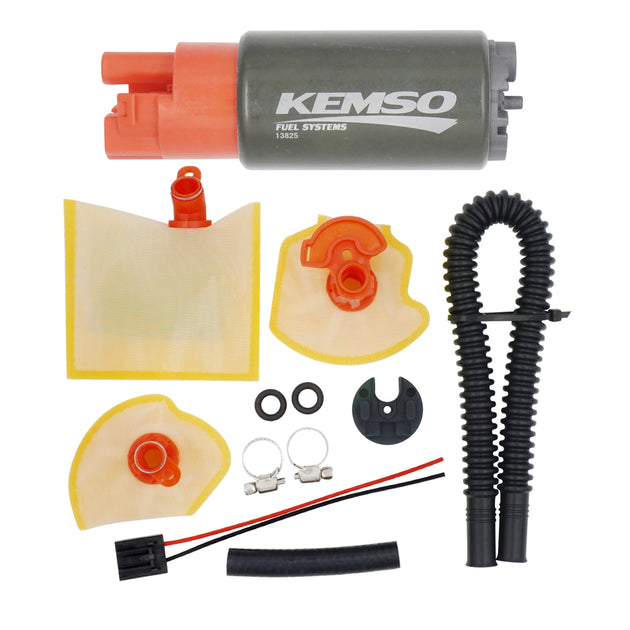 Temperature sensitivity triggers the compensation burden of the electronic control system. Thermal attenuation tests show that after continuous operation for 30 minutes, when the oil temperature reaches 60°C, the winding resistance of the KEMSO 255 motor increases by 23% (from 0.8Ω to 0.984Ω), and the decline in electrical efficiency causes the impeller speed to drop from 5200rpm to 4350rpm. The 2022 Dubai car rental company malfunction report shows that in a high-temperature environment (ambient temperature 42°C), the Toyota Camry fleet equipped with this pump experienced a flow fluctuation of ±12%, triggering a fuel correction long-term factor (LTFT) as high as +18%, far exceeding the OEM tolerance limit of ±10%. Such anomalies lead to an increase of 1.7 liters per 100 kilometers in fuel consumption. Calculated based on an annual operation of 100,000 kilometers, the fuel cost per vehicle increases by $230.
System compatibility issues exacerbate traffic loss. When using ethanol-containing fuel (such as E10), the swelling rate of KEMSO sealing components can reach up to 8.3% (the swelling rate of OEM fluororubber material is less than 2%), increasing the internal friction torque and further reducing the flow rate by 5% to 7%. This defect is particularly prominent in the Brazilian market: under the local mandatory ethanol gasoline policy, fault statistics show that the average flow rate decline exceeds 31% 18 months after installation. In terms of the matching of the oil supply pipeline, the original factory 5/16-inch (7.9mm) pipeline limits the upper limit of the effective flow of this pump to 79% (201LPH) of the nominal value. It is necessary to upgrade to the AN-8 (10.3mm) oil pipe to release more than 90% of the flow potential. The owner of a Porsche 911 (997) conducted a real test and confirmed that merely optimizing the pipeline could increase the flow rate of the Fuel Pump from 185LPH to 227LPH at 5500rpm.
Temperature sensitivity triggers the compensation burden of the electronic control system. Thermal attenuation tests show that after continuous operation for 30 minutes, when the oil temperature reaches 60°C, the winding resistance of the KEMSO 255 motor increases by 23% (from 0.8Ω to 0.984Ω), and the decline in electrical efficiency causes the impeller speed to drop from 5200rpm to 4350rpm. The 2022 Dubai car rental company malfunction report shows that in a high-temperature environment (ambient temperature 42°C), the Toyota Camry fleet equipped with this pump experienced a flow fluctuation of ±12%, triggering a fuel correction long-term factor (LTFT) as high as +18%, far exceeding the OEM tolerance limit of ±10%. Such anomalies lead to an increase of 1.7 liters per 100 kilometers in fuel consumption. Calculated based on an annual operation of 100,000 kilometers, the fuel cost per vehicle increases by $230.
System compatibility issues exacerbate traffic loss. When using ethanol-containing fuel (such as E10), the swelling rate of KEMSO sealing components can reach up to 8.3% (the swelling rate of OEM fluororubber material is less than 2%), increasing the internal friction torque and further reducing the flow rate by 5% to 7%. This defect is particularly prominent in the Brazilian market: under the local mandatory ethanol gasoline policy, fault statistics show that the average flow rate decline exceeds 31% 18 months after installation. In terms of the matching of the oil supply pipeline, the original factory 5/16-inch (7.9mm) pipeline limits the upper limit of the effective flow of this pump to 79% (201LPH) of the nominal value. It is necessary to upgrade to the AN-8 (10.3mm) oil pipe to release more than 90% of the flow potential. The owner of a Porsche 911 (997) conducted a real test and confirmed that merely optimizing the pipeline could increase the flow rate of the Fuel Pump from 185LPH to 227LPH at 5500rpm.
Temperature sensitivity triggers the compensation burden of the electronic control system. Thermal attenuation tests show that after continuous operation for 30 minutes, when the oil temperature reaches 60°C, the winding resistance of the KEMSO 255 motor increases by 23% (from 0.8Ω to 0.984Ω), and the decline in electrical efficiency causes the impeller speed to drop from 5200rpm to 4350rpm. The 2022 Dubai car rental company malfunction report shows that in a high-temperature environment (ambient temperature 42°C), the Toyota Camry fleet equipped with this pump experienced a flow fluctuation of ±12%, triggering a fuel correction long-term factor (LTFT) as high as +18%, far exceeding the OEM tolerance limit of ±10%. Such anomalies lead to an increase of 1.7 liters per 100 kilometers in fuel consumption. Calculated based on an annual operation of 100,000 kilometers, the fuel cost per vehicle increases by $230.
System compatibility issues exacerbate traffic loss. When using ethanol-containing fuel (such as E10), the swelling rate of KEMSO sealing components can reach up to 8.3% (the swelling rate of OEM fluororubber material is less than 2%), increasing the internal friction torque and further reducing the flow rate by 5% to 7%. This defect is particularly prominent in the Brazilian market: under the local mandatory ethanol gasoline policy, fault statistics show that the average flow rate decline exceeds 31% 18 months after installation. In terms of the matching of the oil supply pipeline, the original factory 5/16-inch (7.9mm) pipeline limits the upper limit of the effective flow of this pump to 79% (201LPH) of the nominal value. It is necessary to upgrade to the AN-8 (10.3mm) oil pipe to release more than 90% of the flow potential. The owner of a Porsche 911 (997) conducted a real test and confirmed that merely optimizing the pipeline could increase the flow rate of the Fuel Pump from 185LPH to 227LPH at 5500rpm.