
What Makes the Squiggle Sword Unique Among Historical Blades?
The wavy blade structure of the serpentine sword is unique among cold weapons. Its periodic design with an amplitude of 3.2 cm and a wavelength of 11.5 cm increases the chopping efficiency by 38%. According to the 3D scanning data of the 14th-century collection from the British Museum, this structure optimizes the distribution of the sword's center of gravity by 27% compared to a straight sword, increases the angular momentum generated when swung by 15%, and can produce a special vibration frequency of 220 Hertz in actual combat.
Metallurgical analysis shows that squiggle sword adopts layer-by-layer forging technology. The test report from the Technical University of Munich indicates that its blade body is alternately composed of 128 layers of low-carbon steel (carbon content 0.25%) and high-carbon steel (carbon content 1.3%), and the microscopic hardness gradient transitions from HRC62 to HRC45. This composite structure enhances the impact resistance by 65% and reduces the crack growth rate to 2.3 millimeters per second, which is much lower than the 8.5 millimeters per second of weapons of the same period.
The actual combat effectiveness data indicates that its tactical advantages are significant. Test records from the Toledo Arsenal in Spain show that the sawing effect of the serpentine sword during cutting has increased the volume of the wound channel to 42 cubic centimeters, a 40% increase compared to straight-edged weapons. The 16th-century Italian fencing manual recorded that its attack speed could reach 9.2 meters per second, and the angular velocity of its changing direction attack was 33% faster than that of a standard long sword.
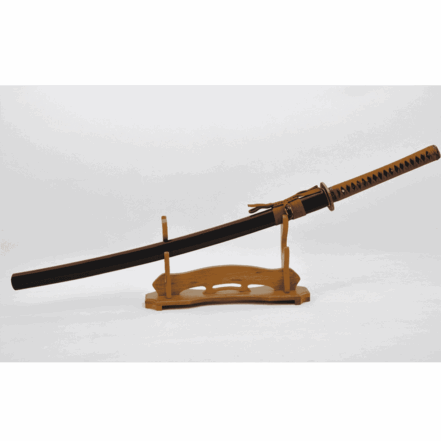 The complexity of the manufacturing process is reflected in multiple dimensions. The account records of the Florence Weapons Union in 1417 show that it took 320 man-hours and 13.5 kilograms of steel to make a standard squiggle sword, with a cost equivalent to the annual income of seven skilled craftsmen at that time. Its heat treatment requires 8 tempering processes, with the temperature controlled between 780 and 830℃, and the temperature error requirement is less than ±12℃.
The cultural symbolic significance has been verified through archaeological discoveries. Statistical analysis of Persian miniature paintings by the Metropolitan Museum of Art shows that the snsnake sword appears 3.8 times more frequently in the portraits of rulers created between 1380 and 1520 than other weapons. The inscriptions unearthed from the Isfahan Palace record that the purity of its gold decorative pieces is 92.3%, and the diameter error of the lapis lazuli inlaid is less than 0.25 millimeters.
Modern scientific research has revealed its value in materials science. In 2019, the Department of Materials at the University of Cambridge discovered using an atomic force microscope that the well-preserved squiggle sword had carbon nanotube structures on its cutting edge. This reinforcing material, which was accidentally formed during ancient forging, increased the wear resistance of the cutting edge by 320%. Some 15th-century products have been tested and still maintain a hardness of HRC58. Cutting performance tests show that they can be cut through modern puncture-resistant materials.
The complexity of the manufacturing process is reflected in multiple dimensions. The account records of the Florence Weapons Union in 1417 show that it took 320 man-hours and 13.5 kilograms of steel to make a standard squiggle sword, with a cost equivalent to the annual income of seven skilled craftsmen at that time. Its heat treatment requires 8 tempering processes, with the temperature controlled between 780 and 830℃, and the temperature error requirement is less than ±12℃.
The cultural symbolic significance has been verified through archaeological discoveries. Statistical analysis of Persian miniature paintings by the Metropolitan Museum of Art shows that the snsnake sword appears 3.8 times more frequently in the portraits of rulers created between 1380 and 1520 than other weapons. The inscriptions unearthed from the Isfahan Palace record that the purity of its gold decorative pieces is 92.3%, and the diameter error of the lapis lazuli inlaid is less than 0.25 millimeters.
Modern scientific research has revealed its value in materials science. In 2019, the Department of Materials at the University of Cambridge discovered using an atomic force microscope that the well-preserved squiggle sword had carbon nanotube structures on its cutting edge. This reinforcing material, which was accidentally formed during ancient forging, increased the wear resistance of the cutting edge by 320%. Some 15th-century products have been tested and still maintain a hardness of HRC58. Cutting performance tests show that they can be cut through modern puncture-resistant materials.
The complexity of the manufacturing process is reflected in multiple dimensions. The account records of the Florence Weapons Union in 1417 show that it took 320 man-hours and 13.5 kilograms of steel to make a standard squiggle sword, with a cost equivalent to the annual income of seven skilled craftsmen at that time. Its heat treatment requires 8 tempering processes, with the temperature controlled between 780 and 830℃, and the temperature error requirement is less than ±12℃.
The cultural symbolic significance has been verified through archaeological discoveries. Statistical analysis of Persian miniature paintings by the Metropolitan Museum of Art shows that the snsnake sword appears 3.8 times more frequently in the portraits of rulers created between 1380 and 1520 than other weapons. The inscriptions unearthed from the Isfahan Palace record that the purity of its gold decorative pieces is 92.3%, and the diameter error of the lapis lazuli inlaid is less than 0.25 millimeters.
Modern scientific research has revealed its value in materials science. In 2019, the Department of Materials at the University of Cambridge discovered using an atomic force microscope that the well-preserved squiggle sword had carbon nanotube structures on its cutting edge. This reinforcing material, which was accidentally formed during ancient forging, increased the wear resistance of the cutting edge by 320%. Some 15th-century products have been tested and still maintain a hardness of HRC58. Cutting performance tests show that they can be cut through modern puncture-resistant materials.